The Interface in Action
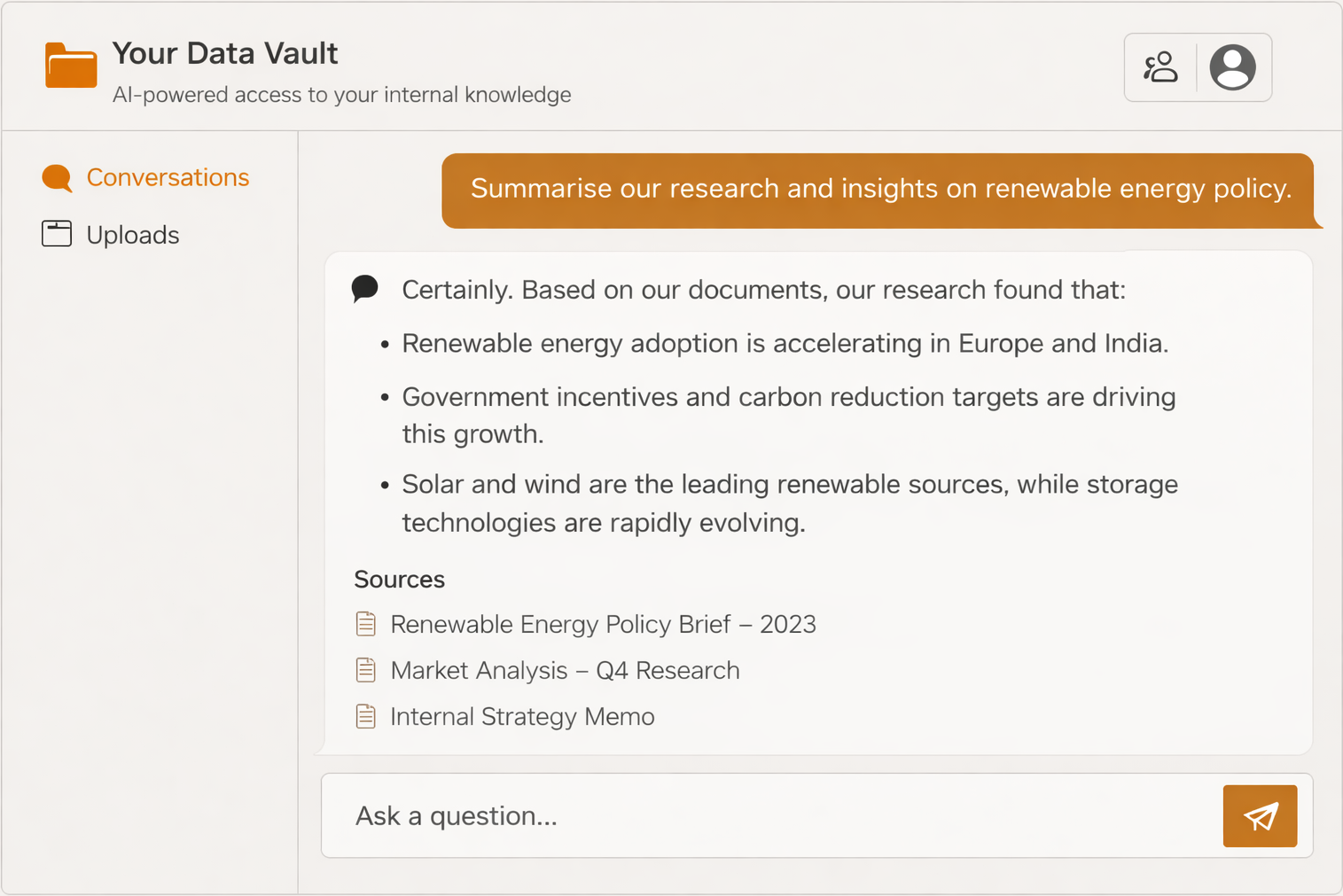
Ask questions in natural language. Receive structured answers grounded in your organisation's documents, with clear references to source materials.
NSQTech transforms scattered documents and archives into intelligent knowledge systems that answer questions, reveal insights, and accelerate decisions.
Every organisation produces an enormous amount of knowledge over time. Reports, presentations, legal documents, research notes, correspondence, internal memos, archives, and operational documentation accumulate across departments and systems.
However, in most organisations, that knowledge becomes increasingly difficult to access. Documents are stored across shared drives, cloud platforms, internal systems, archives, and personal folders.
NSQTech helps organisations address this challenge by transforming their existing information into an intelligent knowledge system. Instead of simply storing documents, organisations gain the ability to ask questions of their own knowledge and receive clear, relevant answers.
To transform large collections of documents and data into a secure, searchable intelligence layer that can answer questions and generate insights for the organisation.
"What did we conclude in our previous research on this topic?"
"Have we handled similar cases before?"
"What insights exist in our historical reports about this issue?"
The system retrieves relevant information from the organisation's documents and generates structured answers grounded in those sources. This transforms static archives into a dynamic knowledge resource.
Implementing a knowledge system requires more than installing software. It involves carefully structuring the organisation's data so that it can be understood, searched, and used intelligently.
The first step is understanding where knowledge exists within the organisation. Most organisations store information across many locations—document repositories such as Google Drive or Dropbox, internal file servers, knowledge management platforms, email archives, and research databases.
During the discovery phase we identify the major repositories of knowledge and map how information flows across the organisation. The objective is to identify the most valuable sources of organisational knowledge and determine how they should be incorporated into the knowledge system.
Once knowledge sources are identified, the next step is to ingest the relevant documents into a structured processing pipeline. Ingestion systems are designed to connect to multiple document sources and retrieve information in a controlled and secure manner.
At this stage, strict attention is paid to security and data governance. For organisations with sensitive data, the entire system can be deployed within the organisation's own infrastructure, ensuring that documents remain under the organisation's control.
Raw documents cannot be used directly by intelligent retrieval systems. They must first be processed and structured. During this stage, documents are analysed and divided into smaller segments that capture meaningful pieces of information.
Metadata is preserved or enhanced to capture context such as document type, author, date, department, and topic. This structured representation of the organisation's documents forms the foundation for intelligent retrieval.
Once documents have been processed, they are indexed using modern information retrieval techniques. Traditional search systems rely primarily on keyword matching. While useful, this approach often fails when users phrase questions differently from the way information is written in documents.
Modern knowledge systems use semantic indexing, converting document segments into numerical representations known as embeddings. These embeddings capture the meaning of text rather than just the words themselves, allowing the platform to retrieve information based on meaning.
Security is a central requirement in any organisational knowledge system. NSQTech designs systems that respect existing access controls and organisational policies, including user authentication, role-based access control, and integration with enterprise identity systems such as SSO.
Users can only access documents and information that they are authorised to view. The knowledge system enforces these permissions automatically. Deployments can be configured so that all data remains within the organisation's own infrastructure.
Once documents are indexed and secured, the knowledge system can begin answering questions. When a user asks a question, the system retrieves the most relevant document segments using semantic search techniques.
These retrieved pieces of information are then combined and analysed to generate a clear response. This approach is known as retrieval-augmented generation. The result is an answer that is grounded in the organisation's own documents rather than generic information from external sources.
The final layer of the system is the user interface. Users interact with the organisation's knowledge through a conversational interface similar to a chat system, allowing them to ask questions in natural language rather than navigating complex search tools.
The system retrieves relevant documents and generates structured answers while providing references to the original sources. This ensures that users can verify and explore the underlying material.
Ask questions in natural language. Receive structured answers grounded in your organisation's documents, with clear references to source materials.
One of the most important principles of NSQTech knowledge systems is maintaining control over organisational data. Many organisations are concerned that sending internal documents to commercial AI services could expose sensitive information.
Our systems are designed to prevent this. Data can remain entirely within the organisation's infrastructure. External language models may be used in carefully controlled ways when appropriate, but sensitive documents themselves are not transmitted or retained by external providers.
This architecture allows organisations to benefit from modern AI capabilities while maintaining strict control over their knowledge assets.
NSQTech designs knowledge systems for a wide range of use cases. At one end of the spectrum are individual knowledge systems—personal "second brain" implementations that allow professionals to organise and interact with their personal notes, research materials, and documents.
At the other end are large organisational knowledge platforms serving hundreds or thousands of users. These enterprise deployments may include integration with multiple document repositories, secure user authentication systems, role-based permissions, and large-scale document indexing.
Regardless of scale, the underlying objective remains the same: to transform stored information into accessible intelligence.
When implemented effectively, an organisational knowledge system changes how people interact with information.
Instead of searching for documents, users ask questions.
Instead of relying solely on memory or manual research, teams can access the collective knowledge of the organisation instantly.
This unlocks value from years of accumulated work and insight.
For many organisations, the knowledge they need already exists. The challenge is making that knowledge accessible.
NSQTech exists to solve that problem.
Explore how NSQTech can help unlock the knowledge within your organisation.
Explore Consultation Options